Why Early Math Skills Matter for Children: Building a Strong Foundation with Abacus Learning
The early years are when children begin building number sense, and hands-on abacus learning can give those early mathematical ideas a clear and practical foundation.
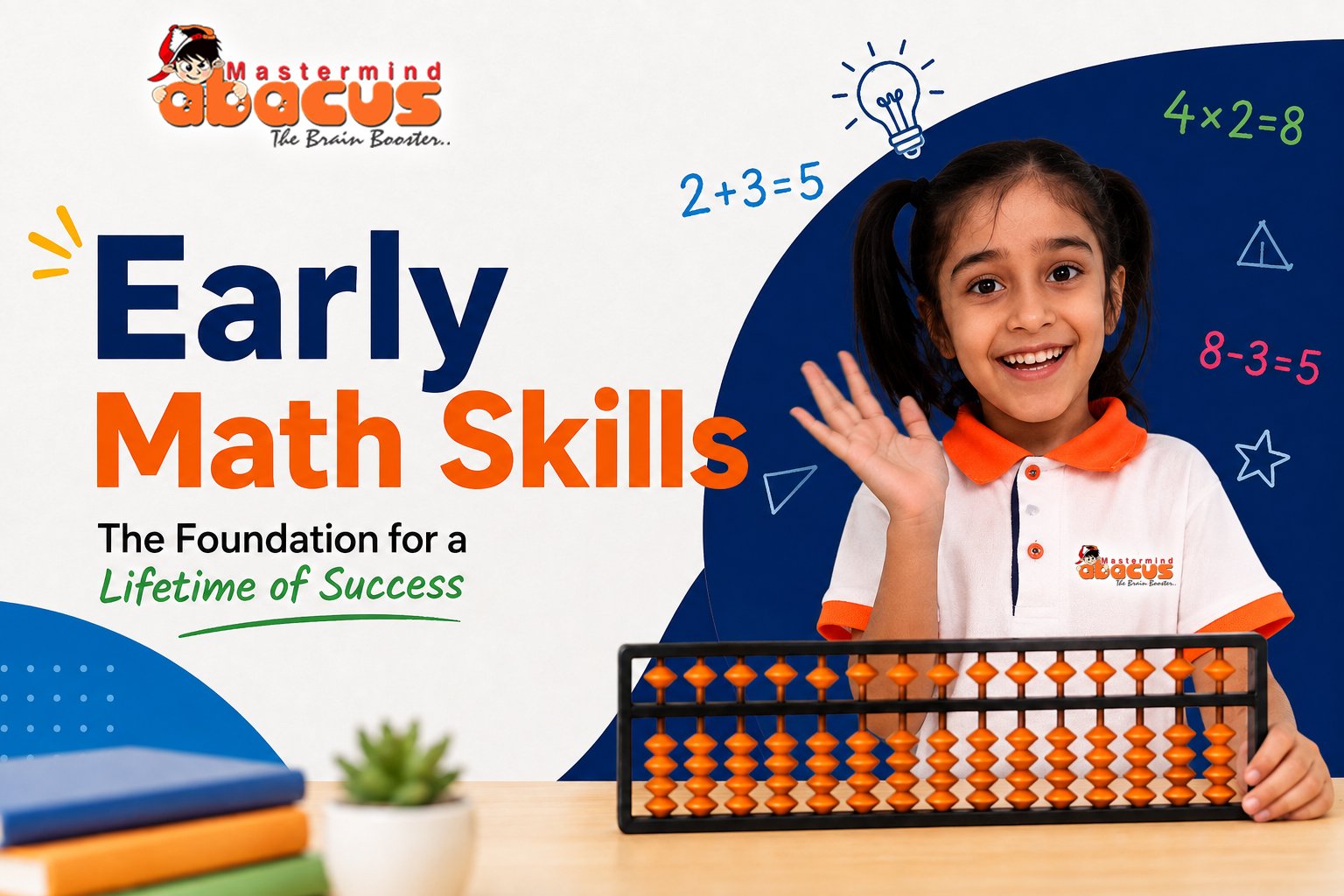
Long before a child learns multiplication tables or starts solving pages of written sums, they are already learning what numbers mean. They notice that one plate has more biscuits than another, that two toys become more when another is added, and that objects can be counted, grouped and compared. These everyday experiences are the beginning of number sense. A child does not need advanced mathematics at this stage. They need opportunities to understand quantity, order, comparison and simple relationships between numbers. This is one reason the early years can be such a useful time to build a comfortable relationship with maths.
Making Number Sense Concrete
For a young child, a written number is an idea represented by a symbol. The symbol 6 does not physically look like six things. An abacus helps bridge that gap. When your child moves six beads, they can see and feel a quantity rather than simply repeat the word or recognise the written digit. They can move beads together, separate them, compare positions and begin to notice that numbers have relationships with one another. This is a small but important shift. Instead of learning numbers only as marks on a worksheet, the child starts experiencing numbers as something they can work with.
That physical experience becomes particularly useful as children progress towards mental arithmetic. At first, the child depends on the actual beads. With practice, they become familiar with the positions and movements involved and can gradually begin to imagine the abacus in their mind. The calculation then becomes a combination of number knowledge and visualisation. Research on mental abacus instruction has found that children can develop strong arithmetic skills through this approach, while some studies have also examined its relationship with visuospatial working memory. The value is therefore not simply speed. It is giving children another way to represent and manipulate numbers.
"A child who can picture what a number means has something to think with, not just something to remember."
A Stronger Beginning for School Maths
Early maths does not need to become another source of pressure at home. In fact, the opposite is often more useful. Children learn well when mathematical ideas are introduced at a level they can understand and then repeated often enough to become familiar. Counting, comparing, adding and taking away can gradually become less effortful. Once those foundations are secure, school mathematics has somewhere to go. Place value, written addition, subtraction, multiplication and later fractions all depend on children having a reasonable understanding of how numbers relate to one another.
There is also a confidence issue that parents sometimes overlook. A child who repeatedly experiences maths as confusing can start avoiding it before the work becomes genuinely difficult. They may say, 'I am not good at maths,' when what they really mean is, 'I don't know what to do next.' Early, supportive practice can help prevent that feeling from becoming a habit. Abacus learning is not a guarantee that a child will never struggle with mathematics, nor is it a replacement for school maths. Its role can be much simpler and more useful: giving children regular, manageable experiences with numbers so that mathematical thinking becomes familiar rather than intimidating.
For parents considering abacus classes for children, the most useful question is therefore not whether an abacus will make a child unusually fast at calculations. Ask whether the learning environment is helping your child understand numbers, practise patiently, make corrections without embarrassment and gradually work more independently. Those habits matter far beyond one arithmetic exercise. The early years are an opportunity to make maths feel like something your child can explore and learn, rather than a subject they have already decided is difficult.
A good foundation is rarely dramatic. It is built through ordinary moments of understanding repeated over time. A child recognises a quantity without counting every object. They notice that adding one changes a number in a predictable way. They solve something that previously seemed difficult and realise they can do it. These are the beginnings of mathematical confidence. For a young learner in Bhubaneswar, Cuttack or Khordha, a structured abacus programme can be one practical way of giving those foundations regular attention while keeping learning active and age-appropriate.
Parents can also explore the Master Mind Abacus centres across Odisha when considering a structured learning programme for their child.